Articles
FoodTech puts the spotlight on the future of food
arrow_backTo the overview21 October 2026
- 3D Printing Technology
- Work environment and clothing
- Focus on sustainability
- Food Lab
- Trade publications/media
- Professional organizations
- Food Packaging
- Food Processing
- Research institutes
- Hygienic and food safety
- Ingredients and additives
- IT and Data
- Educational institutions
- Water and Energy
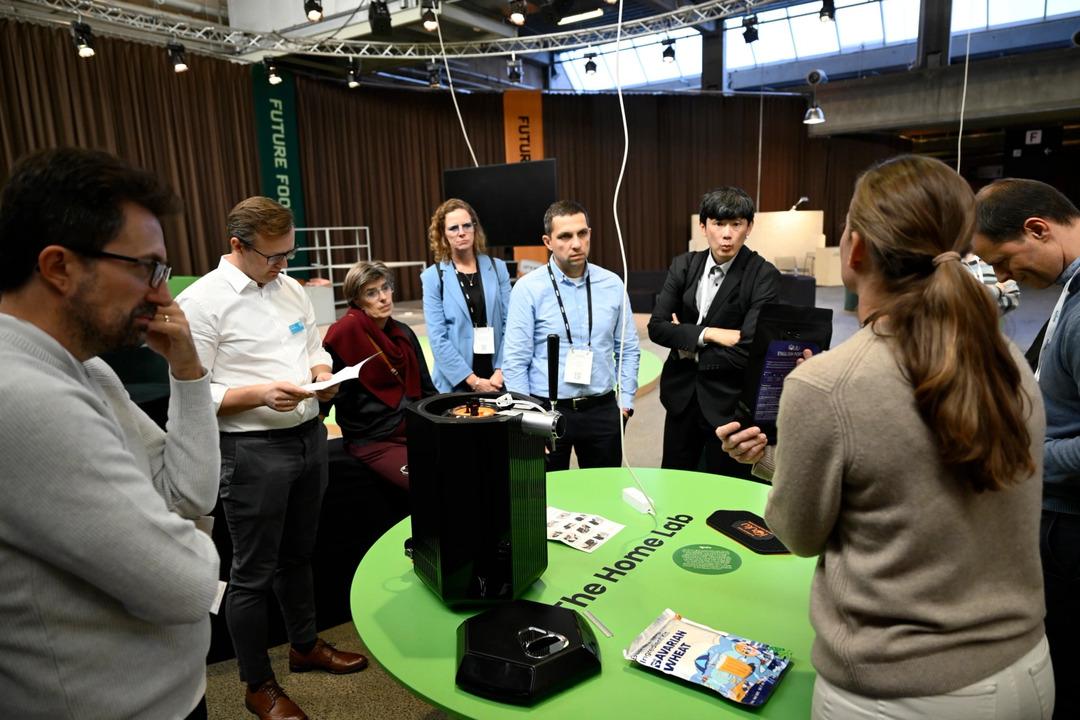
From artificial intelligence and digital twins to cultivated meat and new ways of producing protein. With Food Life Science, FoodTech focuses on the technologies and solutions that can help shape the future of food production. The Nordic region’s leading destination for food technology will bring the industry together at MCH Messecenter Herning from 27–29 October 2026.
Visitors to FoodTech can look forward to experiencing some of the technological breakthroughs already taking shape in the food industry as Food Life Science puts the spotlight on the future of food production. Here, tangible technological solutions and international pioneers come together in an exhibition area and a stage programme offering insights into both current advances and future opportunities. Co-organiser InnovationLab has high expectations for the area.
“Food Life Science gives visitors a glimpse into the future of food production through technologies that already exist today. We are presenting some of the leading pioneers working with, among other things, cultivated meat, AI-personalised foods and new ways of producing protein. These technologies point in entirely new directions and have the potential to transform the food industry as we know it,” explains Mads Thimmer, CEO and Co-founder of InnovationLab, and continues:
“Our ambition is not only to inspire visitors but also to ensure they leave with concrete ideas they can take back to their own businesses. This could include how AI can be used in product development or what the food industry can learn from the pharmaceutical industry. At the same time, we place great emphasis on dialogue. All presentations are delivered live, and the audience can ask the specialists questions directly and gain first-hand insight into their experiences and perspectives.”
Among the speakers, Mads Thimmer highlights Helder Cruz, a pioneer in cultivated meat, and Melissa Snover, who has developed technology for 3D-printing personalised dietary supplements. He also points out that Siemens will present digital twins that use AI to optimise supply chains, while Solar Foods will demonstrate how microorganisms can be used to produce protein using, among other things, CO₂ and electricity. The technologies can also be experienced through practical examples in the exhibition area.
Significant untapped potential
At Siemens, there is considerable potential in the use of digital twins, which can help optimise both product development and production in the food industry.
“AI and digital twins hold enormous potential for the food industry. By digitally simulating, for example, the properties and shelf life of ingredients, companies can test thousands of recipes in just a few hours rather than spending months in the laboratory. This can reduce development time, limit the need for physical testing and minimise raw material waste. At the same time, the technology can help identify quality issues before they arise in production,” says Magnus Rasmussen, Zone Portfolio Developer and Digital Twin Lead at Siemens, elaborating:
“In my view, the greatest untapped potential lies in connecting early-stage product development with scaling up to industrial production. When developing plant-based foods, for example, or seeking to reduce sugar content without changing texture, processes quickly become complex. Here, AI and digital twins can predict how a recipe will perform at scale, ensuring that good ideas are not lost because the journey from the laboratory to production becomes too long and costly.”
As part of Food Life Science, Siemens will present the interplay between digital twins and industrial AI, using PepsiCo’s work with supply chains as a practical example. According to Magnus Rasmussen, companies should measure the value of the technology by tangible results rather than technological advances alone. These include shorter development times, fewer physical trials, lower energy and raw material consumption, as well as the financial benefits of implementing the solutions.
Making the opportunities tangible
Food Life Science aims to bridge the gap between technological opportunities and practical application in the food industry. At MCH A/S, the ambition is to make new technologies and insights from other industries accessible and relevant to companies across the sector.
“There is significant potential in the technologies and solutions we are highlighting through Food Life Science. Through practical presentations and concrete examples in the exhibition, we want to make these opportunities tangible and demonstrate how the food industry can benefit from, among other things, insights from the pharmaceutical industry, AI and digital twins. Our ambition is for visitors to gain new knowledge and inspiration that they can take back and apply in their own businesses,” says Jacob Rasmussen, Project Manager at MCH A/S.
FoodTech takes place at MCH Messecenter Herning from 27–29 October 2026.








Responsibility for content on this site
Information, images, product descriptions, videos, certifications, sustainability claims, and other content on company profiles are uploaded and maintained by the individual exhibitors.
Exhibitors are solely responsible for ensuring that their content is accurate, properly documented, and legally compliant, including compliance with applicable regulations concerning marketing, sustainability claims, and intellectual property rights.
MCH A/S solely provides the platform and does not, as a general rule, verify the content.